A method of CT imaging where the techniques of using non-circular orbits around the target and spectral imaging are combined resulting in fewer metal artifacts and higher image quality.
Problem:
Imaging techniques such as CT and Cone Beam Computed Tomography (CBCT) are highly susceptible to metal artifacts in interventional scenarios. Metal surgical tools and implants can compromise image quality, introducing distortions that obstruct critical structures of interest. While existing solutions, such as non-circular orbits—where the X-ray source and detector follow complex paths around the patient rather than simple circular ones—have been somewhat effective in reducing these artifacts, image quality and imaging capabilities can further enhanced by incorporating spectral imaging methods. Not only does this combination further reduces metal artifacts, it allows the distinction of structures of interest that are other indistinguishable in conventional single energy imaging.
Solution:
This invention is a method that combines two existing CT technologies of non-circular orbit and a spectral imaging technique of material decomposition to help reduce artifacts and improve image quality. This method effectively reduces streaking and shading artifacts that can distort images due to metals, and it also distinguishes targets that may look similar in standard CT images.
Advantages:
- Reduction of artifacts caused by metal objects.
- Improved quality of scans.
- Ability to differentiate various materials such as bleed and contrast extravasation.
- Enablement of post-operative assessment at the point of care in the operating room.
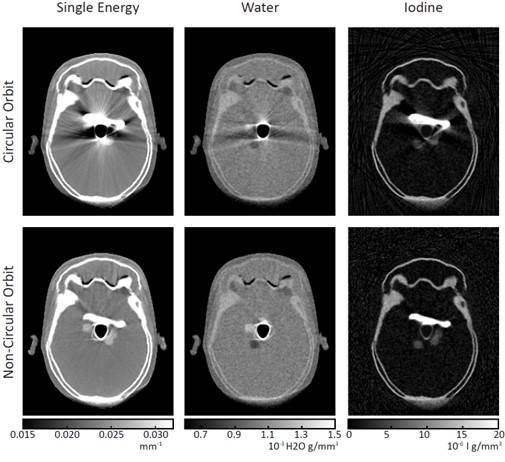
A simulation of head phantoms with metal implants, simulated bleeds, and simulated regions of extravasation was performed and imaged using single energy techniques versus spectral techniques and non-circular orbits versus circular orbits. The combined sinusoidal orbit and spectral technique allowed images with reduced metal artifacts and clear differentiation between the bleed zones and extravasation. Compared with the circular orbit images, there is a clear presence of metal artifacts, and the single energy method (traditional CT) is unable to differentiate between the two materials. The figure above shows the comparison of reconstruction results from circular and non-circular orbits using single energy and spectral measurements.
Case ID:
24-10682-TpNCS
Web Published:
6/18/2025
Patent Information:
| App Type |
Country |
Serial No. |
Patent No. |
File Date |
Issued Date |
Expire Date |