A field programmable photonic architecture that enables nonlinear computation making it suitable to use the advantages of photonics in the field of AI.
Problem:
Reconfigurable computing with field-programmable devices offers the flexibility to adapt hardware to changing workloads, and integrating photonics into these systems enables fast, energy-efficient data processing. However, current photonic systems are limited to linear operations, which constrains their usefulness for artificial intelligence (AI) applications. Neural networks require nonlinear operations such as activation functions to model complex patterns and perform effective learning. Although nonlinear optics has been explored, light–matter interactions in existing materials are typically too weak and difficult to reprogram. This makes it challenging to implement dynamic, tunable nonlinear functions in photonic hardware. Therefore, to use photonic computing for AI, an innovative approach is needed that enables programmable, reconfigurable nonlinear operations within integrated photonic architectures.
Solution:
The inventors developed a field-programmable photonic architecture that uses all-optical control to dynamically reshape the material response to light in standard semiconductors, enabling programmable nonlinear light–matter interactions. This approach allows the implementation of polynomial nonlinear functions of various orders, enabling the construction of polynomial nonlinear networks that support in situ photonic learning and inference.
Technology:
The inventors created a programmable photonic chip using a special semiconductor material called InGaAsP, which can absorb or amplify light. By shining a second light (the pump), they control how this material responds to a signal light passing through. This enables the implementation of programmable nonlinear functions—such as high-order polynomials—directly on-chip. These nonlinear transformations form reconfigurable connections between input and output ports, creating a photonic polynomial network. The architecture supports fast, energy-efficient data processing and in situ training, making it well-suited for artificial intelligence and other optical computing applications.
Advantages:
- Field-programmable photonic nonlinearity facilitates the configuration of polynomials of various orders
- The Polynomial network designed for this field-programmable nonlinearity is inherently more suitable for our photonic system, surpassing conventional architectures composed of reconfigurable linear weights and fixed nonlinear activations in many cases
- This polynomial network allows for a simplified design of the computational hardware, facilitating a reduction in the required depth of the computing network
- A polynomial nonlinear network capable of in situ photonic learning
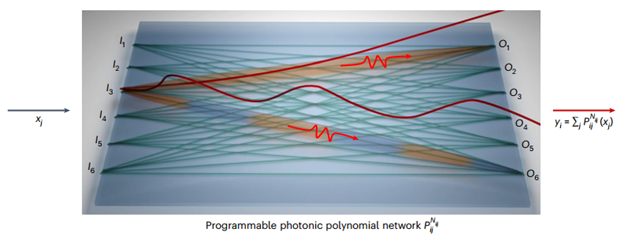
Field programmable photonic polynomial microprocessor, where light signals travel between input and output ports through programmable nonlinear connections. Each connection applies a custom polynomial transformation, controlled by spatially patterned optical pumping. This enables reconfigurable, on-chip nonlinear computation using light, simplifying hardware, and supporting real-time AI processing.
Case ID:
25-11118-tpNCS
Web Published:
8/4/2025
Patent Information:
| App Type |
Country |
Serial No. |
Patent No. |
File Date |
Issued Date |
Expire Date |