Behavioral measures lie at the core of nearly all neuroscience research. For example, studies of anxiety disorders often measure how mice freeze after being startled, or interact with a novel stimulus. State-of-the-art methods for quantifying behavior use video-based pose tracking, measuring body position on the order of millimeters and with timing up to a few hundred frames per second. While this approach has provided important insights, many behaviors generate little or no appreciable body displacement, such as jaw clenching or subtle motor tremors, rendering them invisible to a purely visual analysis, no matter how advanced.
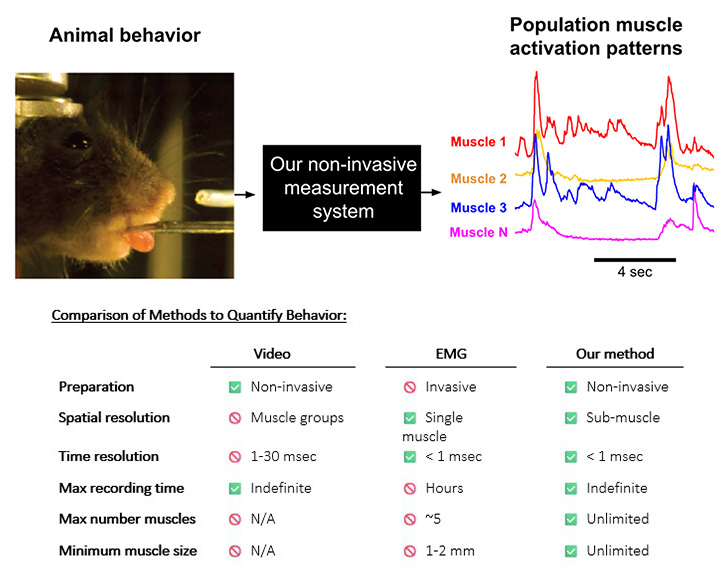
An alternative approach to video is to measure muscle recruitment. Indeed, all behavior begins with muscles, and thus muscle contraction is the ultimate measure of nervous system output. Unfortunately, the current “gold standard” for muscle recording, electromyography (EMG), suffers from significant drawbacks that limit its utility: difficulty scaling beyond a handful of muscles, degradation over days prohibiting longitudinal studies, and not being suitable for small muscles in rodents.
Solution:
We have developed a non-invasive system to record activity in dozens of muscles simultaneously at speeds up to thousands of samples per second. Our approach allows these measurements to be readily made in awake mice during behavior. It also enables the repeated recording of identified muscles over days to months. This unprecedented precision and scale allows for entirely new kinds of experiments, allowing researchers to more completely characterize behaviors at the fundamental level of muscle recruitment.
Our non-invasive measurement system (see figure below) is robust and will be straightforward to deploy in most rodent behavior labs, creating the potential for widespread adoption. Clinical researchers will be able to use our system to perform sensitive, high-throughput screens for motor, psychiatric, and neurological disorders or drug effects. And it will empower basic researchers to perform foundational studies that can finally relate neural activity to the direct outputs of the nervous system, illuminating a vital connection from the brain to the world.
Advantages:
Behavior is the ultimate readout of nervous system function. We have developed a method for monitoring movement as well as the principal effectors of behavior, muscles, at unprecedented scale and resolution. Our approach is poised for widespread adoption and will enable new breakthroughs in both clinical and basic research.
Case ID:
25-10891-TpNCS
Web Published:
8/11/2025
Patent Information:
| App Type |
Country |
Serial No. |
Patent No. |
File Date |
Issued Date |
Expire Date |