Technology allowing efficient formation, delivery, isolation, and enrichment of single-copy Human Artificial Chromosome (HAC) for use in research, plant production, gene and cell therapy and more.
Problem:
Existing gene-editing techniques have limitations due to their reliance on viruses for delivery, restricting their packaging capacities. A more potent approach, HACs, can carry larger gene payloads alongside natural chromosomes without altering native genomes. However, a quarter century after the first human artificial chromosomes (HACs) were developed uncontrolled multimerization and DNA rearrangement still hinder their use.
Solution:
The inventors devised a method to produce HACs to create functional centromeres and engineered single-copy HACs allowing them to bypass the multimerization process. Furthermore, the inventors developed methodologies to deliver, isolate, and enrich these single-copy HACs, providing additional advantages such as stability, high rate of delivery, and high-efficiency production. This technology creates a potential for inserting multiple genes and gene cassettes with control elements into cells without altering the native genome.
Advantages:
- Avoiding DNA multimerization and rearrangement
- High efficiency of HAC formation, delivery, isolation, and enrichment
- Ability to insert multiple genes and gene cassettes with control elements into cells
Potential Applications:
- Generation of cells and animals for research (e.g. HAC injections into mouse embryos, inducing pluripotency or differentiation state etc)
- Generation of plants with novel properties for agricultural applications (e.g., pest-resistant, high-yield, improved dietary value crops etc)
- Humanization of animal cells for xenotransplantation
- Cell therapy
- Gene therapy
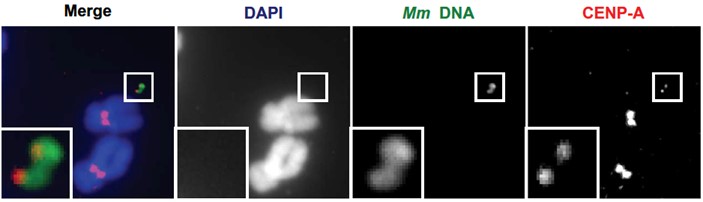
Representative images of a single-copy HAC generated in HT1080 and U2OS cells.
Case ID:
23-10327-TpNCS
Web Published:
9/17/2025
Patent Information:
| App Type |
Country |
Serial No. |
Patent No. |
File Date |
Issued Date |
Expire Date |