A flexible toolkit for human gene editing, activation, and repression that can be applied in orthogonally and in various disease models.
Problem:
There is increasing demand for technologies that can simultaneously edit the genome and regulate the transcriptome without relying on toxic double-stranded breaks. Currently, treating complex diseases such as cancer require correcting genomic point mutations while simultaneously activating or repressing secondary genes that are deregulated. These independent tasks require the co-delivery of multiple large effectors, drastically exceeding the strict packaging limits of modern clinical vectors like AAVs. Therefore, there is a dire need for a single, compact tool that provides orthogonal control over gene editing and expression. Such a unified platform would bypass viral packaging bottlenecks, eliminate CRISPR/Cas9-induced cytotoxicity, and unlock next-generation precision therapies.
Solution:
This invention is a minimal versatile genetic perturbation technology (mvGPT), which combines a prime editor (PE), fusion activator (MPH), and a multiplex array that produces RNA tailored for a variety of genetic perturbations, including genomic editing, gene activation, and gene repression. Importantly, unlike other currently available tools, mvGPT can be used orthogonally – such that gene activation, repression, and editing can be deployed independently and without interference among functions.
Technology:
The invention consists of three main components: an engineered compact prime editor (Prime Editor with Advanced Kernel, or PEAK), a transcriptional activator (MS2–p65–HSF1, or MPH), and an RNA system that produces short RNAs to direct editing, activation, or silencing of specific genes (drive-and-process array, or DAP). DAP, in combination with prime editing guide RNA (pegRNA) and nicking guide RNA (ngRNA), efficiently guides PEAK to target loci to modify DNA. MPH and PEAK are guided by short guide RNA to activate gene transcription. Finally, DAP encodes short hairpin RNA and facilitates gene repression through RNA interference.
Advantages:
- Orthogonal and independent deployment of gene editing, activation, and repression without interference
- Versatile delivery approaches of the mvGPT components (AAV, LV, mRNA, plasmids)
- Compatible with human cells and human disease models
- Does not result in DSB of DNA or cytotoxicity associated with existing gene editing methods
- Proof-of-concept model results in simultaneous 5% correction for the disease-causing gene ATP7B, a 1700-fold activation of the PDX1 gene, and a 93% repression of the TTR gene in a human cell line
- Can be utilized for any application requiring gene editing, activation, and/or repression
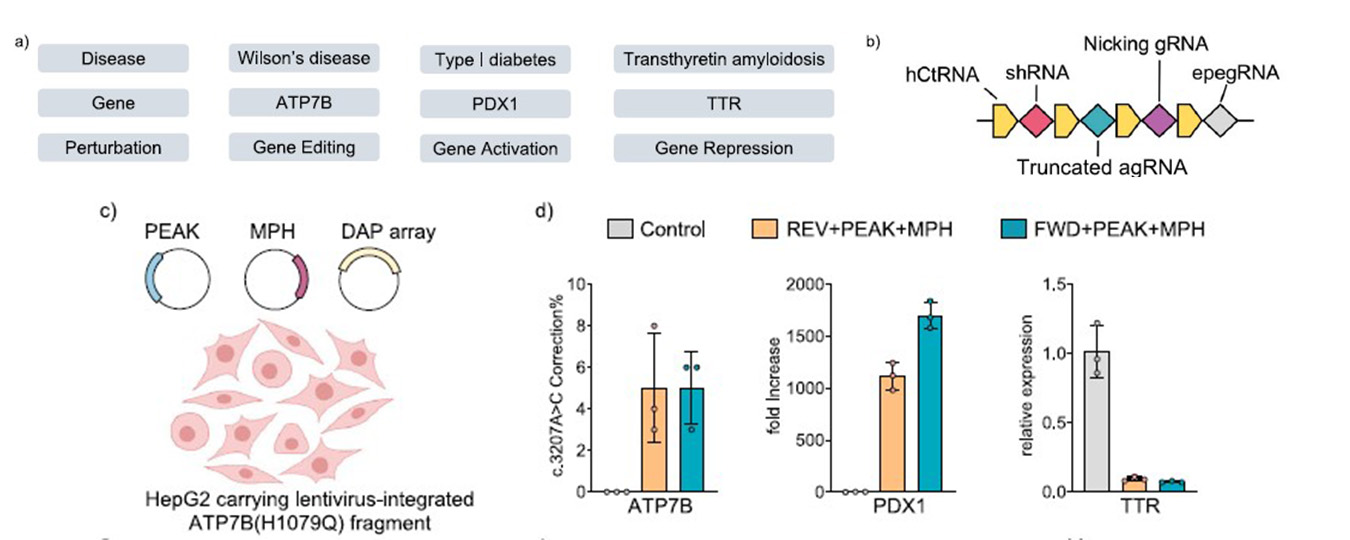
a) Schematic of a hypothetical complex genetic disease model involving Wilson’s disease, Type I diabetes, and Transthyretin amyloidosis. Treatment of the disease model requires orthogonal editing of the ATP7B gene, activation of the PDX1 gene, and repression of the TTR gene.
b) Design of a DAP array encoding a shRNA for gene silencing, a truncated agRNA for gene activation, and a ngRNA and a epegRNA for gene editing.
c, d) Therapeutic genetic perturbation in HepG2 disease cell line transfected by plasmids encoding the DAP array, PEAK, andMPH. REV: the direction of DAP array was reversed as compared to FWD DAP array.
mvGPT: Minimal Versatile Genetic Perturbation Technology, DAP array: Drive-And-Process multiplex array, hCtRNA: human Cysteine tRNA, shRNA: short-hairpin RNA, Truncated agRNA: Truncated activation guide RNA, Nicking gRNA (ngRNA): Nicking guide RNA, epegRNA: engineered prime editing guide RNA, PEAK: A specialized, engineered compact prime editor system used for precise genome editing, FWD: Forward, REV: Reverse, TTR: Transthyretin, PDX1: Pancreatic and Duodenal Homeobox 1, ATP7B : ATPase Copper Transporting Beta