An analytical method and software workflow for quantitatively separating and measuring different carbon forms in urban soils.
Problem:
Organic carbon (OC) is derived from biomass. Black carbon (BC) is a product of the thermal decomposition of OC. Inorganic carbon (IC) exists in nonbiological matter, such as carbon dioxide and carbonates. Urban soils typically contain complex mixtures of all three, but BC and IC are difficult to differentiate from OC. Although accurate characterization of the global carbon cycle is essential for sustainable urban development, there is currently no standardized method to quantify these carbon forms. Conventional methods have been time-consuming, expensive, dangerous, and/or unreliable, in part due to the complexity and temperature-dependence of urban soil composition.
Solution:
Evolved gas analysis (EGA), in which researchers measure the carbon dioxide released during ramped combustion, presents a pathway for directly quantifying carbon. When applied to model mixtures of urban soils, this method outperformed the widely used thermogravimetric analysis (TGA).
Technology:
EGA quantifies carbon by measuring the evolved carbon dioxide, isolating individual thermal peaks, and assigning each peak to the appropriate carbon form using sample-specific local minimums. Unlike TGA, in which the soil sample is measured as a function of temperature, EGA can accommodate samples with disproportionate carbon losses, dehydration and overlapping thermal thresholds.
Advantages:
- Identifies OC, BC, and IC from overlapping thermal signals
- Requires no acid pretreatment
- Outperforms TGA-based methods
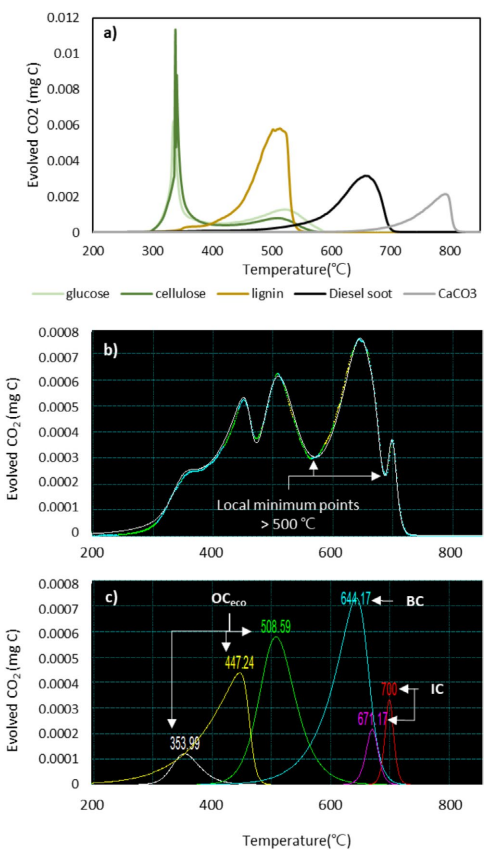
The evolved gas analysis thermograms obtained during ramped combustion. Panel (a) shows the carbon dioxide released at the given temperatures for the reference materials glucose, cellulose, lignin, Diesel soot, and calcium carbonate. Panel (b) shows that of the example carbon dioxide thermogram for a model mixture. The model mixtures contained known amounts of organic carbon, black carbon, and inorganic carbon within a mix of montmorillonite, a natural clay mineral. Panel (c) presents the peak deconvolution result for the model mixture, wherein the overlapping signals are separated by carbon source.
Intellectual Property:
- Non-US Application Pending
Case ID:
26-11375_tpNCS
Web Published:
5/5/2026
Patent Information:
| App Type |
Country |
Serial No. |
Patent No. |
File Date |
Issued Date |
Expire Date |