A method to manipulate tumor-associated macrophages by targeting the mitochondrial electron transport chain, improving the efficacy of immune checkpoint blockade cancer therapies.
Problem:
Many cancer therapeutics work by activating the immune system to attack a tumor. These drugs, known as immune checkpoint blockade (ICB) therapies, commonly fail because cancers develop resistance to ICB therapy. Prognosis is associated with tumor-associated macrophages (TAMs), which exist in pro-tumor and anti-tumor states. Pro-tumor TAMs help tumors recover from therapy by inhibiting immune responses and promoting angiogenesis, limiting ICP therapy efficacy. The ratio of pro-tumor to anti-tumor TAMs is a strong predictor of survival and ICB therapy efficacy, but no available therapies are available to shift the TAM population to an anti-tumor state.
Solution:
This technology addresses a crucial challenge in cancer treatment by regulating the polarization of TAMs within the tumor microenvironment. By downregulating NDUFA4, it promotes anti-tumor TAMs, enhances immune cell recruitment, and inhibits tumor growth. This approach holds promise for boosting the efficacy of immune checkpoint blockade therapies, offering a potential breakthrough in cancer treatment.
Technology:
Researchers examined TAM transcriptomes after exposure to the tumor microenvironment, uncovering a unique bifunctional transcript encoding both a microRNA (miR-147) and a protein (NDUFA4L3). Both miR-147 and NDUFA4L3 collaborate to suppress NDUFA4, a critical component of the mitochondrial electron transport chain (ETC). This downregulation of NDUFA4 results in decreased TAM ETC protein expression, altering TAM polarity. When miR-147 was administered along with an ICB therapy, αPD-1, tumor growth was eliminated. This effect on tumor growth can be attributed to an enhanced recruitment of the body’s immune system, namely T and natural killer (NK) immune cells.
Advantages:
- Provides a method to manipulate TAM polarity, improving efficacy of ICB therapies
- Increases immune infiltration in tumors
- Reduces tumor growth
- Broad application for multiple types of cancer
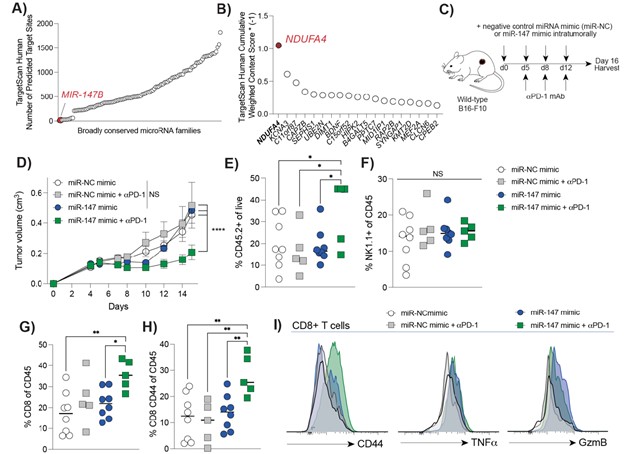
Inhibiting NDUFA4 with miR-147 synergizes with ICB therapy to reduce tumor volume and improve anti-tumor immune response. A) miR-147B is highly selective for NDUFA4 with few other targets. B) NDUFA4 is the highest predicted target for miR-147B. C) Experimental design to test whether miR-147 impacts tumor growth and anti-tumor immune response in mice. D) miR-147 works with ICB therapy αPD-1 to reduce tumor volume. E-I) miR-147 improves anti-tumor immune response by improving tumor infiltration by immune cells.
Case ID:
24-10540-TpNCS
Web Published:
5/13/2026
Patent Information:
| App Type |
Country |
Serial No. |
Patent No. |
File Date |
Issued Date |
Expire Date |