Adaptation of emulsion precursor materials to enable three-dimensional printing of bijels via direct ink writing (DIW) and co-solvent vaporization.
Problem:
Previously developed bijel fabrication methods produce structures with limited macroscale morphologies, such as fibers, particles, and other simple 2D structures. This restriction limits the applicability of bijels, hindering the ability to tailor the external surface area and geometry. Implementing 3D printing processes to control and customize the bijel’s three-dimensional geometry is challenging due to the fluid-like behavior of the conventional bijel precursor materials.
Solution:
The bijel precursor is modified to create a printable precursor ink, using mixtures of fumed silica particles rather than surfactant-colloidal silica particle mixtures. Fumed silica alters the rheological properties of the bijel precursor ink, resulting in a rheological profile suitable for extrusion-based 3D printing. After the ink is extruded, the single phase “ink” phase separates due to evaporation of volatile co-solvent, generating a two-phase water and oil emulsion with a bicontinuous microstructure. The resulting material recovers its rheological properties after deposition and maintains its three-dimensional structure.
Technology:
Fumed silica, as opposed to colloidal silica, serves two roles in the precursor ink; it provides the bijel precursor with the rheological properties needed for printing, and it stabilizes the resulting microstructure after phase separation. The precursor is formulated such that the rheology expresses solid-like behavior at low shear and fluid-like behavior at high shear, with a yield stress of around 300 Pa, which thixotropic behavior. Further, the precursor formulation is optimized to generate bicontinuous emulsion microstructures after co-solvent evaporation post-extrusion, which is stabilized by neutrally wetting fumed silica clusters by carefully selecting the ratio of hydrophilic to hydrophobic fumed silica particles. This enables the bijel ink to be 3D printed via DIW into complex macroscopic shapes.
Advantages:
- Fumed silica is a commercially available rheology modifier
- 3D printing permits continuous assembly of complex macrostructures and layers
- The resulting material expresses a hierarchical structure, with macroscale structures on the scale of centimeters and submicron-sized microstructures
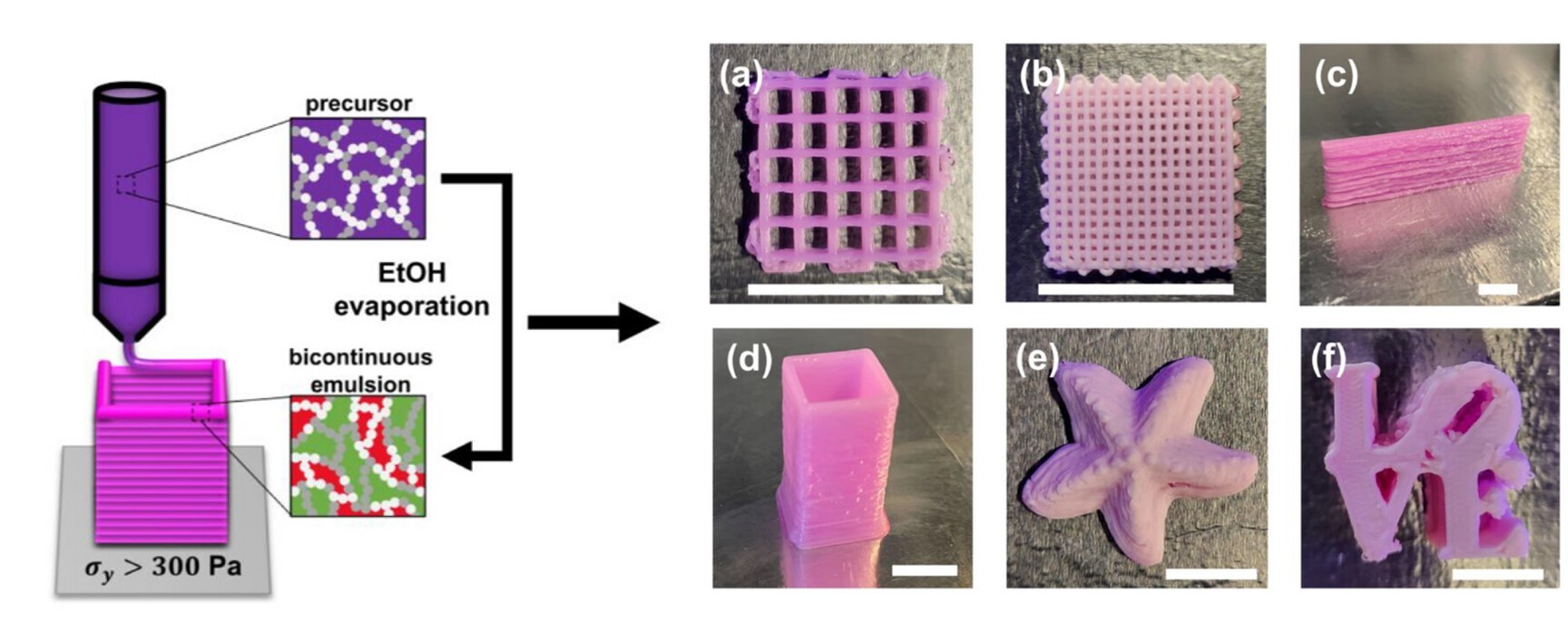
Cartoon rendering of 3D printed bijels formulated with fumed silica as precursor ink capable of generating robust macroscopic structures such as (a) high span woodpile grid, (b) low span woodpile grid, (c) vertical wall, (d) vertical rectangular prism, (e) starfish, and (f) the Philadelphia LOVE sculpture. All scale bars represent 1 cm.
Reference Media:
- Iaccarino, P. R. et. al., Small, 2025 Nov. 03; Vol. 21, Issue 51: e04718
- Lerner, Evan, 2016 Jan. 26; Penn Team Devises Easier Way to Make 'Bijels,' a Complex New Form of Liquid Matter: Penn Today, UPenn
- Haase, M. F. et. al., Adv Mater., 2015 Nov 25; Vol. 27, Issue 44: 7065
Desired Partnerships:
- License
- Co-development (this replaces collaboration or sponsored research)
Case ID:
24-10679-tpNCS
Web Published:
5/15/2026
Patent Information:
| App Type |
Country |
Serial No. |
Patent No. |
File Date |
Issued Date |
Expire Date |