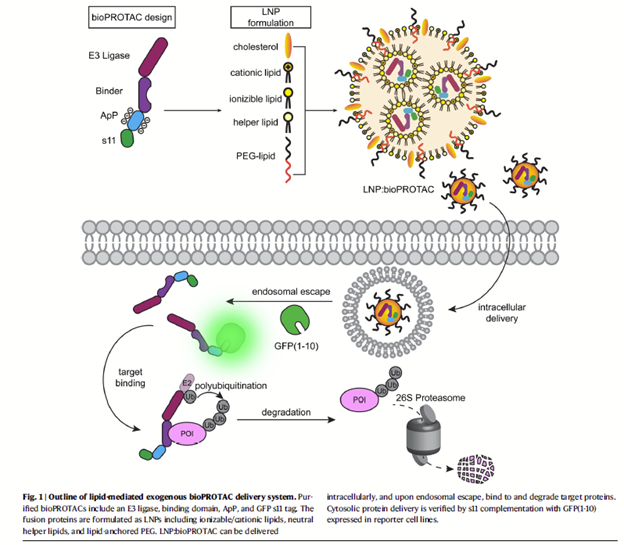
Recombinant fusion bioPROTACs are combined with cationic delivery agents and lipid formulations to enable cytosolic entry and on-demand intracellular degradation of target proteins.
Problem:
Many endogenous proteins remain difficult to modulate with conventional drugs due to limited opportunities for effective small-molecule binding. Protein-degradation strategies can expand what is addressable, but recombinant degraders still face practical intracellular delivery barriers. Common delivery approaches can be complex, cytotoxic, or introduce delays before degradation occurs.
Solution:
This technology provides recombinant fusion proteins and compositions designed to promote cytoplasmic delivery and targeted intracellular protein degradation. The fusion proteins combine an E3 ubiquitin ligase domain with a small protein binding scaffold that targets a selected intracellular protein for degradation. The compositions include a cationic agent to facilitate cytosolic delivery, enabling on-demand degradation in unmodified cells.
Technology:
The core construct is a recombinant fusion protein comprising an E3 ubiquitin ligase domain, a small protein binding scaffold, and an anionic polypeptide. The binding scaffold is selected to recognize a target intracellular protein intended to be degraded intracellularly via the E3 domain’s mechanism. Formulations pair the fusion proteins with cationic agents and can use lipid nanoparticle (LNP) approaches to enhance intracellular delivery and degradation performance.
Advantages:
- Provides a recombinant fusion-protein degrader format designed for cytoplasmic delivery and on-demand intracellular action
- Modular architecture links target recognition (binding scaffold) with degradation function (E3 ligase domain)
- Compositions leverage cationic delivery agents and lipid formulation options to support intracellular delivery and activity
Applications:
- Oncology: Use intracellular delivery of fusion-protein degraders to reduce levels of intracellular proteins implicated in cancer and evaluate effects on cellular proliferation models.
- Inflammatory disorders: Apply targeted intracellular degradation to study and modulate disease-relevant signaling proteins in inflammation-focused cellular assays.
- Neurodegenerative disorders: Evaluate whether lowering intracellular proteins associated with neurodegeneration alters cellular phenotypes using delivered recombinant degraders.
- Undruggable target validation: Rapidly test whether targeted intracellular protein depletion produces a desired biological effect without requiring conventional small-molecule inhibition.
Stage of Development:
- Preclinical – robust in vitro efficacy and delivery demonstrated
Partnerships:
- Licensing
- Collaboration
- Sponsored Research
Case ID:
24-10698-aiNCS
Web Published:
5/29/2026
Patent Information:
| App Type |
Country |
Serial No. |
Patent No. |
File Date |
Issued Date |
Expire Date |