A microfluidic chip that models blood-brain barrier biology using brain vascular and supporting cells, with optional neural progenitors and controlled agent exposure and mechanical stretching capabilities.
Problem:
The blood-brain barrier is a selective endothelial barrier that limits delivery of many agents to the central nervous system. This barrier hampers development of CNS therapeutics and diagnostic tools because many agents do not cross it effectively. Blood-brain barrier models are needed to study transport-related mechanisms and biological or pathological processes associated with the barrier.
Solution:
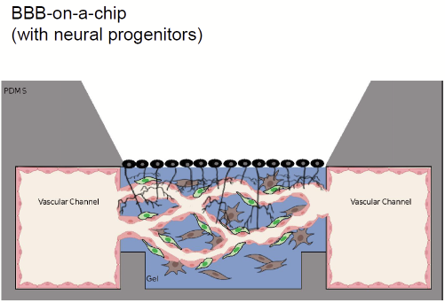
This technology provides a microfluidic chip designed to model blood-brain barrier function using defined cellular compartments and relevant brain cell types. The platform supports introducing an agent into the endothelial lumen, and in some embodiments also to a neural progenitor compartment, followed by assessment of effects. The device can also apply stretching to channel contents to enable controlled studies of deformation-associated responses.
Technology:
The chip includes a bottom region with a center channel adjacent to at least one side channel, and an upper region separated from the bottom region by a porous membrane. The center channel contains a cell-laden medium that includes pericytes and astrocytes, while the side channel contains brain microvascular endothelial cells that form a lumen. In certain embodiments, neural progenitors are disposed in the upper region in fluid communication with the bottom region, and the device can include media reservoirs and a mechanism configured to effect stretching.
Advantages:
- Compartmentalized design enables controlled delivery of agents to defined on-chip regions for response assessment
- Blood-brain barrier-relevant co-culture architecture integrates endothelial cells with pericytes and astrocytes within a microfluidic format
- Optional stretching feature supports studies of mechanically induced changes in blood-brain barrier and neurovascular unit-related cell environments
Applications:
Stage of Development:
- Prototype
- Proof-of-Concept
Partnerships:
- Licensing
- Sponsored Research
- Collaboration
Case ID:
22-10101-aiNCS
Web Published:
5/29/2026
Patent Information:
| App Type |
Country |
Serial No. |
Patent No. |
File Date |
Issued Date |
Expire Date |