A quick and inexpensive method to detect cancer early by exponentially amplifying rare and scarce cancer mutations.
Problem:
Early cancer detection is challenging due to the low levels of cancer-indicating mutant DNA compared to healthy, wild-type DNA. The background noise from the substantial amounts of healthy DNA overwhelms mutant signals. Some current approaches include - amplification refractory mutation system (ARMS)-PCR; next generation sequencing (NGS); CRISPR-mediated Ultra-sensitive detection of Target DNA (CUT)-PCR; and dynamic allele-specific hybridization (DASH). These approaches are often unable to enrich the mutant DNA to a high enough level for accurate detection. Furthermore, they are costly and time-intensive, making them impractical for a real-time point-of-care detection setting.
Solution:
Haim H. Bau and his team combined two technologies, CRISPR-Cas9 and isothermal recombinase polymerase amplification (RPA), to develop the Programmable Enzyme-Assisted Selective Exponential Amplification (PASEA) assay. The exponential increase in mutant DNA fraction (MAF) that is achieved compared to the current methods allows for much easier early cancer detection in a shorter period of time.
Technology:
PASEA is inspired by Darwin’s “survival of the fittest” wherein the scarce cancerous mutant DNA fraction with the superior trait is amplified exponentially and quickly dominates the landscape. The wild-type DNA are also amplified, but at a much slower rate since they are detected and cleaved via CRISPR-Cas9. In just 20 minutes, the initially scant mutant DNA can be amplified from 0.01% up to 70% mutant DNA fraction (via RPA), followed by inexpensive Sanger sequencing to determine the genetic sequence of the mutant DNA. The assay can be applied to a microfluidic chip for point-of-care detection if desired.
Advantages:
- In 20 min, PASEA enriches MAF 3-222x better than DASH and CUT-PCR (in 60 min) depending on MAF % before enrichment outlined in table:
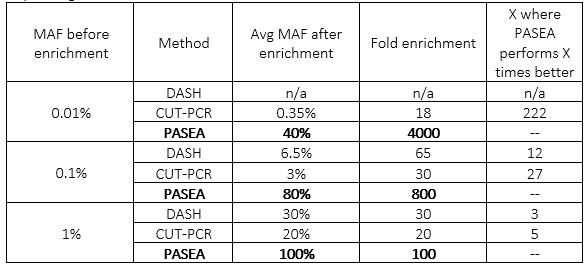
- PASEA is three times faster than DASH and CUT-PCR for incubation times (20 min vs. 60 min)
- Can be implemented in real time point-of-care setting
- PASEA resulted in same sensitivity and accuracy as ARMS-PCR combined with NGS but lower cost and less time
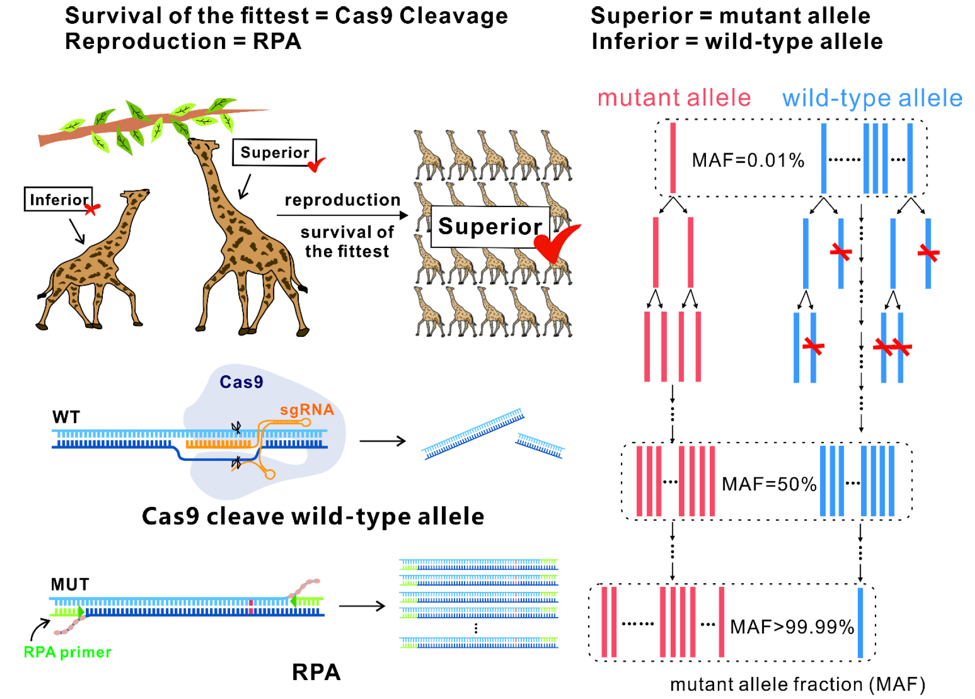
PASEA inspired by Darwin’s theory “survival of the fittest,” combining the CRISPR-Cas9 and RPA technologies to exponentially amplify the mutant DNA fraction for cancer screening.
Desired Partnerships:
- License
- Co-Development (This replaces collaboration or sponsored research)
Case ID:
21-9723-tpNCS
Web Published:
6/12/2026
Patent Information:
| App Type |
Country |
Serial No. |
Patent No. |
File Date |
Issued Date |
Expire Date |