Scalable manufacturing technique to produce micro or nano-scale surface wrinkles using roller curvatures, UV curing and oxygen plasma treatment.
Problem:
Surface wrinkles are commonly observed in polymer films when the stress exceeds a critical value producing material instabilities. Recently, wrinkling instability has been utilized as a versatile patterning platform to affect, modify, or control material parameters, including surface adhesion, texturing, friction, and structural colors. Micro- and nanoscale surface wrinkles have wide ranging applications in stretchable electronics, tunable optics, and coatings with controllable wettability and adhesion. The present state of the art for wrinkle fabrication uses techniques such as thermal treatment, swelling, mechanical stretching, and UV curing. However, these processes are limited to lab-scale and are unsuitable for continuous manufacturing. The lack of scalability of these procedures hampers the commercial potential of wrinkled surfaces.
Solution:
This technology is a mechanism for continuous large-scale manufacturing of micro- and nanoscale surface wrinkles. It utilizes various shapes and curvatures defined by 3D printed rollers, UV curing, and oxygen plasma treatment to generate wrinkles ranging from hundreds of nanometers to tens of microns. The roller shape largely influences the type and size of wrinkles fabricated, whereas wrinkle topologies can be defined by UV curing and oxygen plasma treatment.
Advantages:
- Scalable operation
- Continuous manufacturing
- Industrial production potential
- Crack-free wrinkles
- No use of expensive and complex vacuum systems, like the current state-of-the-art
Applications:
- Large-scale manufacturing of surface wrinkles
- Stretchable electronics
- Tunable optics
- Coatings with controlled wettability and adhesion
- Microfluidics
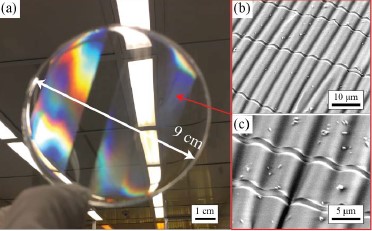
Surface wrinkles able to control material properties of polymer films are produced across (a) large-areas by a combination of oxygen plasma treatment and sequential rolling. (b)-(c) wrinkles span the nanometer to micrometer scale, as demonstrated with scanning electron micrograph
Stage of Development:
- 1D grating, 2D herringbone and labyrinth patterns were generated on PDMS substrate using this technique on a lab scale
- Studies are on-going to understand the fundamentals of wrinkle mechanism by finite element analysis
- Roll-to-roll prototypes using UV curable polymers will be developed in the near future
Case ID:
18-8646-TpNCS
Web Published:
6/16/2026
Patent Information:
| App Type |
Country |
Serial No. |
Patent No. |
File Date |
Issued Date |
Expire Date |