Elimination of cracks in self-assembly using a wet template and positively charged particles produces relatively large-area nanolattices with enhanced tensile strength.
Problem:
Nanolattice fabrication is currently dominated by 3D-printing that employs 2-photon polymerization. However, structures made in this fashion feature imperfections which lead to tensile strength that is well below theoretical limits. Additionally, the 2-photon method can take upwards of 16 times longer than methods using self-assembly. Current self-assembly methods suffer from concentrated areas of stress from cracks which result from a dry template producing evaporation step.
Solution:
To ameliorate the problems of a dry-template creation step, and avoid producing face centered cubic lattices from spherical nanoparticles with intrinsic cracking, the inventors use glycerol and dispersion polymerization of positively charged particles to ensure simultaneously that nanolattices are crack-free and that electro-deposition of metal occurred.
Technology:
To produce nanolattices, a conductive material is placed in colloidal suspension and then heated. The subsequent evaporation is energetically favorable to the formation of face-centered cubic lattices, which act as a template. A nanolattice is then impressed onto the opal via electrodeposition of nickel, and the underlying template is removed (see Figure). The inventors avoid the negative tendency of nickel to concentrate in template cracks, by including glycerol during evaporation. Through the addition of this low vapor pressure alcohol and positively charged particles to the electrodeposition medium, nickel can adhere seamlessly onto the template.
Advantages:
- Order of magnitude improvements in ultimate tensile strength over other porous metals
- Smaller volumes with higher load capability
- Self-assembly method improves scalability and speed over 3D-printing options
- 20,000x increase in crack-free area compared to other methods of self-assembly
- Significant potential to improve nanolattice application in high-power density batteries, heat and mass exchangers plus selective infiltration membranes
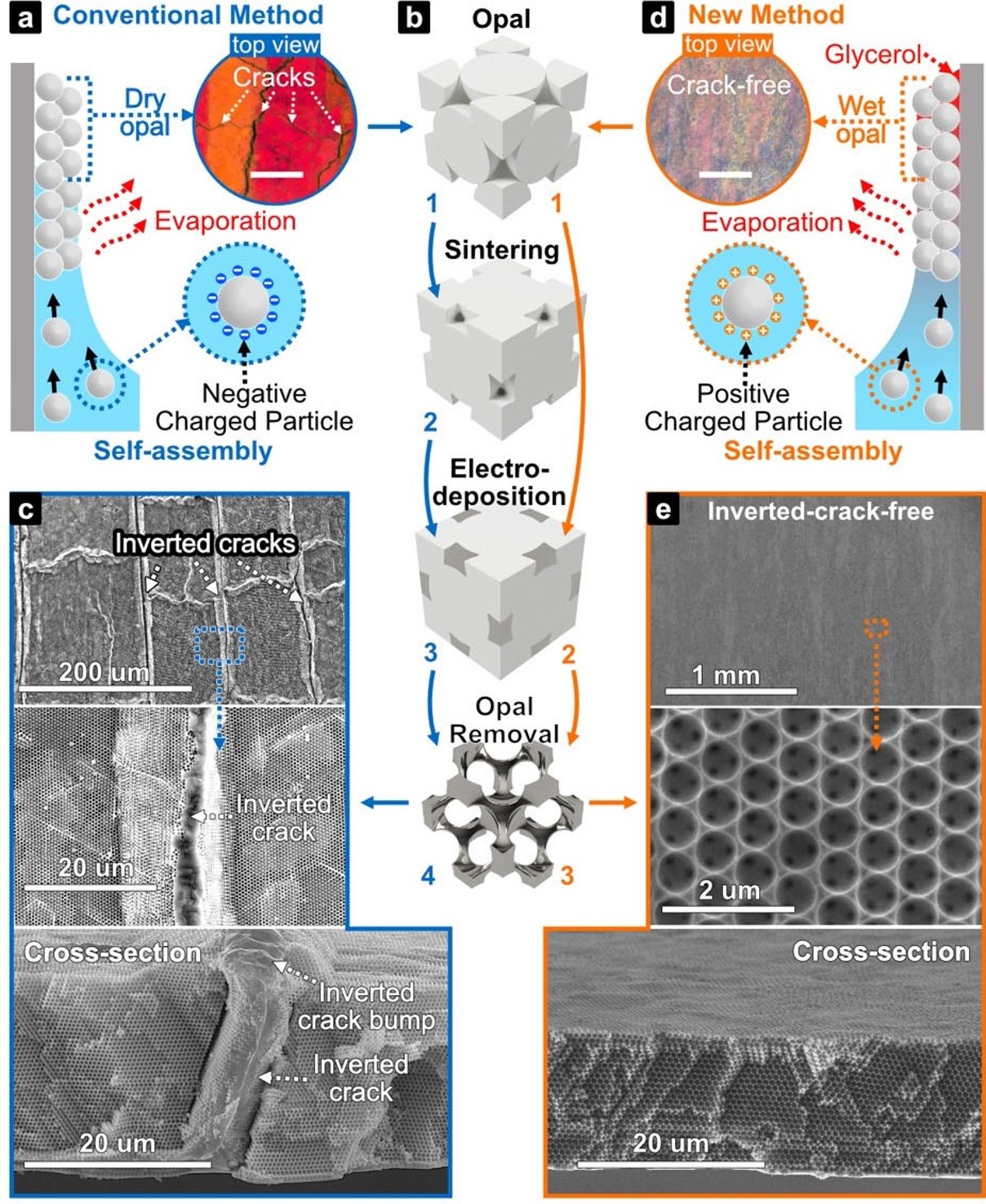
Conventional method of self-assembly (a and c) compared to glycerol facilitated self-assembly of template and positive particle-based metal electrodeposition to produce nanolattices that are crack-free (d and e).
Case ID:
21-9735-TpNCS
Web Published:
6/25/2026
Patent Information:
| App Type |
Country |
Serial No. |
Patent No. |
File Date |
Issued Date |
Expire Date |