A neuroprosthetic implant that uses existing nerve or muscle signals to replace damaged muscle and restores movement
Problem:
While prosthetics often replace entire limbs, smaller nerve or muscle injuries are common, severely impact daily life, and have limited treatment options. Facial paralysis is one example, where nerve damage causes muscle weakness, asymmetry, and loss of expression. Restoring a natural smile requires two complex surgeries using donor nerves and muscles, leading to scars, long recovery, and inconsistent outcomes. Alternative nerve stimulation approaches are also limited, as target muscles may be damaged or missing and electrodes can be unstable. There is a clear need for a more reliable, less invasive solution that restores muscle function without relying on damaged anatomy.
Solution:
The inventors developed an off-the-shelf neuroprosthetic implant that replaces damaged muscle and restores function without relying on weakened or missing facial structures. Only one operation is needed for this device. During implantation, the surgeon measures the needed dimensions, accesses the opposite-side facial nerve and muscles, and implants the electrode, graft, and battery to enable controlled, functional movement.
Technology:
The inventors developed a neuroprosthetic implant consisting of several components: a sensor or electrode, a power source, and a multi-stable graft. Starting from the patient thinking about a motor function, the signal travels from the brain to the sensor, which then communicates the signal to the power source, a biocompatible battery, after adequate processing. The power source will then transmit an electrical current to the reactive portion of the implanted graft. The graft is constructed of FDA-approved biocompatible materials capable of multiple stable configurations. Upon activation, the graft will then contract or relax via power source signal.
Advantages:
- Obviates the need for a complex, multi-stage surgical procedure and other donor sites
- Lowered risk of unintended injury to important facial structures by avoiding dissection of facial blood vessels
- Holds potential to solve any singular nerve/muscle group injury in the body with known dimensions and adequate power
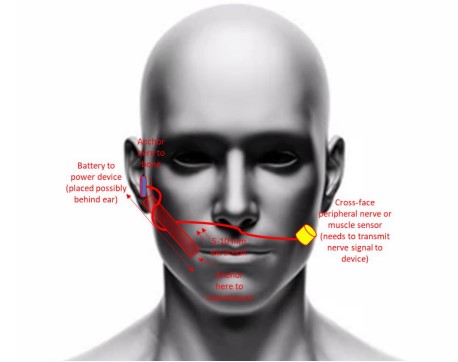
Schematic of the Invented Device for its Primary Application in Restoring Facial Movement
Case ID:
22-9777-TpNCS
Web Published:
6/25/2026
Patent Information:
| App Type |
Country |
Serial No. |
Patent No. |
File Date |
Issued Date |
Expire Date |