A 3D gyroid polymer microlattice enables new type of lithium-metal batteries by reducing non-unifrom Li etching in lithium metal anodes.
Problem:
Lithium (Li) metal pouch cells represent the future of lithium-metal batteries due to their thinness and high capacity. But one caveat has held back these cells: significant volume increases after cycling mitigate the benefits of lithium anodes. During Li deposition, Li tends to nucleate randomly and causes the formation of voids in the electrodes. Those voids lead to nonuniform Li etching during cycling, and eventually, dramatic swelling. To suppress swelling, many studies have exerted high pressure to stabilize Li deposition, which is impractical for most applications.
Solution:
3D-printed polymer gyroid is used as a scaffold to control molecular interaction between Li, polymer, and the liquid electrolyte. This geometric, mechanical, and chemical control avoids applying high pressure to suppress swelling while maintaining the thinness of Li pouch cells.
Technology:
To achieve high-rate, swelling-free, and pressure-free Li anodes, the polymer is coated with amines, a functional group that binds to Li+ and facilitates Li+ ion transport. A small overpotential distributes the flowing metal throughout the hollow polymer, resulting in voids-free Li growth. By coating the polymer with -SO2F- groups they react with Li+ and form a protective solid electrolyte interphase (SEI) at the polymer-Li-electrolyte triple-phase. This layer of protection stabilizes Li deposition under pressure-free conditions.
Advantages:
- Pressure- and swelling-free fabrication of Li metal pouch cells
- A 3D polymer gyroid features a high Li volume fraction, high Li-polymer contact area, mechanical robustness, and manufacturability
- Surface F- functional group helps form protecting LiF interphase
- A 308 Wh kg-1/2.1 Ah Li pouch cell achieves 80.2% capacity retention over 226 cycles with less than 7% swelling
- With 2.6-fold excess Li, the pouch cell can achieve 860 cycles with 80.1% retention in capacity
- With 5-fold excess Li, the cell can achieve an 1180-cycle life with 74.1% retention in capacity
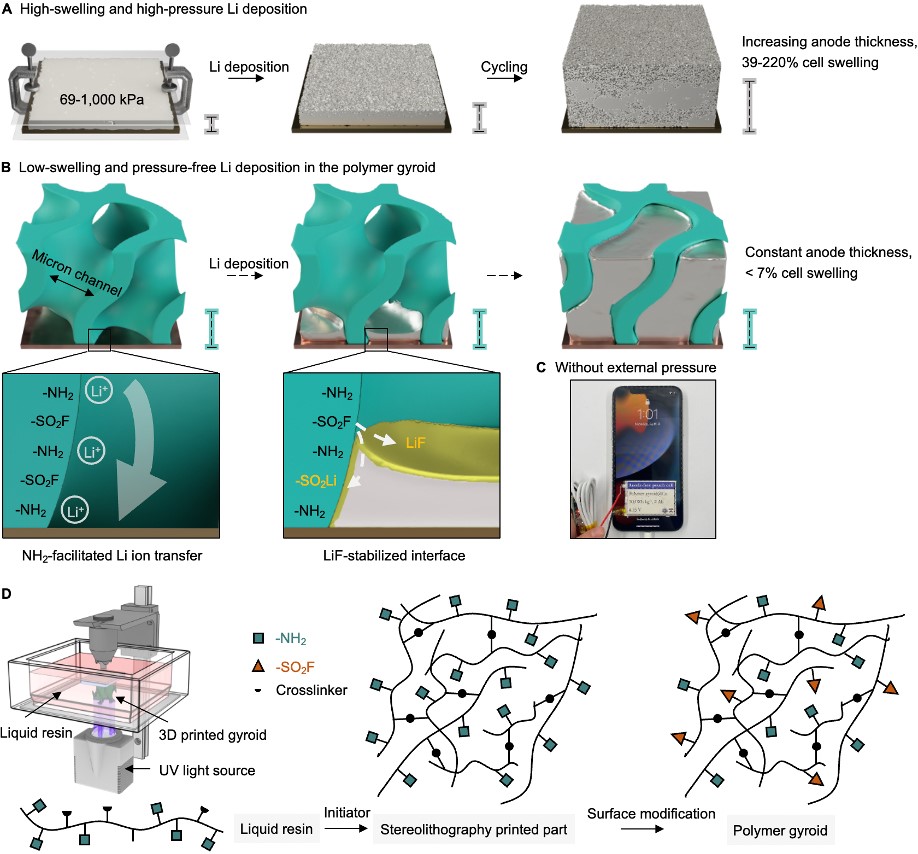
A. Traditional high-swelling and high-pressure Li deposition. B. The low-swelling and low-pressure Li deposition method used in the disclosure. C. Pressure-free operation of Li metal pouch cells. D. Schematic illustration of the 3D printing process to make the gyroid, and further functional group modifications.
Case ID:
23-10161-TpNCS
Web Published:
6/26/2026
Patent Information:
| App Type |
Country |
Serial No. |
Patent No. |
File Date |
Issued Date |
Expire Date |