An electrochemical system for continuously powering robots through the ingestion of energy-dense organic molecules, utilizing a new electrolyte that enables the maximization of material performance. This system also provides a method for recycling and reusing the materials used in the stomach.
Problem:
The electrification of existing battery-powered systems is hampered by the significant time required for charging and recovery. Due to this inherent limitation, robots and electric vehicles have restricted operational time; overcoming these constraints requires a substantial increase in energy and power density. Conversion reaction battery systems that use lithium-sulfur (Li-S) and Li-air can meet the energy demand aspect, but are difficult to recharge or recover, making them uneconomical. For example, the mass-produced rechargeable batteries have energy densities below 250 Wh kg-1, while short-range all-electric aircraft typically require 750 to 2,000 Wh kg-1. These factors contribute to the increased cost of these vehicles, and consequently, handling the energy needs remains a significant challenge throughout their lifetime.
Solution:
An energy system composed of a converter, a catholyte, and an anode, where the catholyte and anode can be replenished, recovered, and “recharged” for re-use. The method could serve as an alternate strategy that would (a) increase energy density and (2) permit exchange of energy storage to prolong the use time.
Technology:
The inventors developed an electrochemical system that can help rapidly regain energy and power density by ingesting liquids or solids. The solution pairs redox-active organic small molecules stored in a liquid catholyte, such as dimethyl trisulfide (CH3S3CH3), with metal anodes in a refillable electrochemical cell (also referred to as a stomach). This catholyte system could provide continuous energy and meet higher energy and power density demands. To achieve a high current output of 193.5 A kgstomach-1, a current collector is designed, and the catholyte composition is altered to prompt the CH3S3CH3 transport and prevent electrode polarization. Experiments demonstrate that a 43.7 Ah electrochemical cell (stomach) with CH3S3CH3 and Li could achieve an energy density of 918.7 Wh kgstomach-1 and provide power for 23.4 hours in a 24-hour period with 5 refills of catholyte. Unlike fuels in engines and fuel cells, the catholyte and Li are recyclable with electrical input and can be reused in this system.
Advantages:
- This technology can be employed in systems that require a higher energy density.
- This invention could help quickly replenish energy availability in rechargeable systems.
- The catholyte and Lithium utilized in this system can be recycled with electrical input and reused in the system.
- The Li-specific recycling efficiency of 99.98% (lab demonstrated) is a solid advantage.
- For robot and aircraft applications, the system could be cost-efficient than the existing rechargeable batteries and gasoline-based power systems.
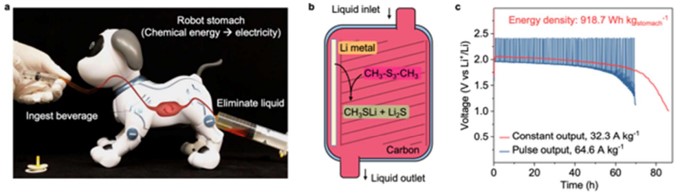
The figure (A) shows the illustration of a stomach-powered robot dog that ingests energy-dense organic small molecules and converts chemical energy into electricity. Figure B depicts the structure of the proposed electrochemical cell with a carbon collector, a porous polymer separator, a Li metal anode, and the case. The plot shown in Figure C is the discharge curves of the electrochemical cell using constant and pulsed current modes.
Case ID:
23-10332-TpNCS
Web Published:
6/26/2026
Patent Information:
| App Type |
Country |
Serial No. |
Patent No. |
File Date |
Issued Date |
Expire Date |