HDAC8-targeting small molecules for kidney disease treatment with improved safety, selectivity, and therapeutic potential.
Problem:
Acute kidney injury (AKI) and focal segmental glomerulosclerosis (FSGS) affect millions of patients worldwide and can contribute to chronic kidney disease and end-stage renal failure, which only has a 5-year survival rate of 35-50%. Despite substantial disease burden, there are currently no FDA-approved therapies that directly target underlying molecular drivers of either condition. Existing treatment approaches primarily focus on symptom management and supportive care rather than halting disease progression. As a result, there remains a significant unmet need for therapies that address the root causes of kidney injury and dysfunction.
Solution:
Histone Deacetylase 8 (HDAC8) is a promising therapeutic target for kidney disease due to its role in regulating gene expression pathways associated with inflammation, fibrosis, and renal injury. Targeting HDAC8 can help address drivers of renal disease, slowing its progression. The inventors developed a class of HDAC8 inhibitors that exhibit potent inhibition with improved selectivity compared to conventional HDAC inhibitors.
Technology:
Most HDAC8 inhibitors rely on a hydroxamic acid (HA) zinc-binding group (ZBG) to target the enzyme’s catalytic zinc ion. The inventors developed compounds featuring a distinct ZBG from those used in existing HDAC inhibitor designs, enabling improved selectivity and reduced off-target activity. By leveraging additional interactions beyond the conventional binding pocket, these compounds exhibit potent and selective HDAC8 inhibition. The molecules’ synthesis involves a modular convergent approach that enables rapid generation and optimization of analogs. The resulting compounds achieve HDAC inhibition with half-maximal inhibitory concentration (IC50) values ranging from 0.007 to 50 μM.
Advantages:
- Potent HDAC8 inhibition with lead compounds achieving IC50 values as low as 7 nM.
- Modular convergent synthesis allowing for rapid generation and evaluation of new compound variants.
- Replaces the traditional HA ZBG with an alternative design, reducing reliance on a motif often linked to safety and specificity concerns.
- Dual-site engagement of both the catalytic region and a distinct HDAC8 binding pocket to improve target recognition compared to traditional inhibitors that rely solely on the conventional active-site interactions.
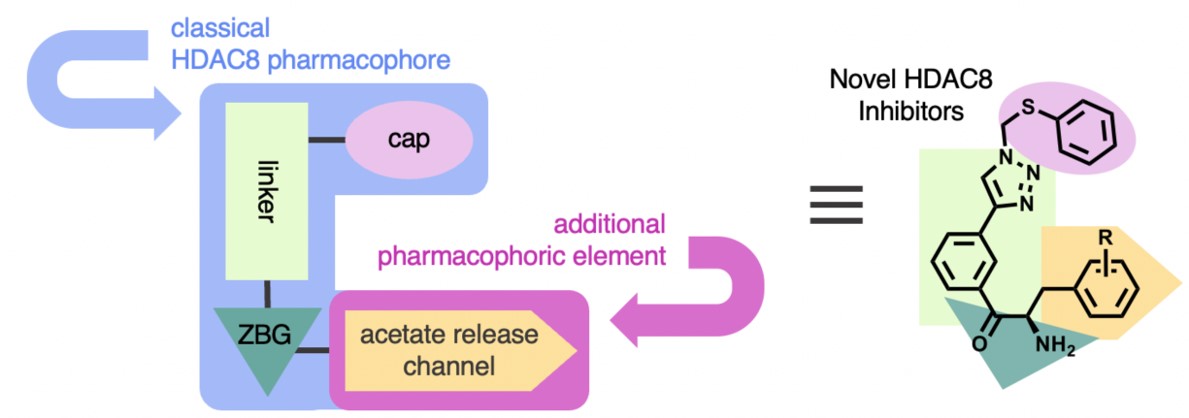
Modular design of the HDAC8 inhibitor small-molecule constructs. Left: schematic representation of the molecular architecture consisting of a cap, linker, and ZBG, and acetate release channel interacting domain. Right: representative chemical structure corresponding to each molecular domain.
Case ID:
26-11392-TpNCS
Web Published:
6/30/2026
Patent Information:
| App Type |
Country |
Serial No. |
Patent No. |
File Date |
Issued Date |
Expire Date |